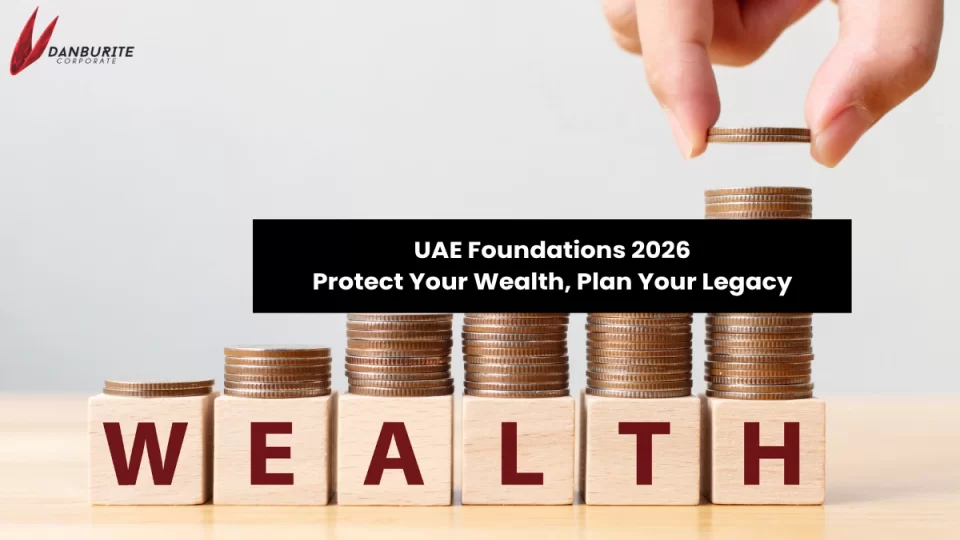
You have spent years building your wealth. Property in Dubai, a business, investments, accounts across borders. But here is a question most people avoid; what happens to all of it if something happens to you?Without the right structure, UAE assets can be frozen, disputed in court, or distributed in ways you never intended. The UAE Foundation changes that permanently.
At Danburite Corporate Services, we are a registered Channel Partner of RAK International Corporate Centre (RAK ICC). We help families, investors, and business owners build legal structures that protect assets, ensure smooth succession, and stand firm for generations.
What is a UAE Foundation?
A Foundation is an independent legal entity, separate from you, your estate, and your personal liabilities. Unlike a trust (which is a contractual arrangement), a Foundation has its own legal personality. It owns assets in its own name, has its own governance structure, and continues to exist perpetually, including after the Founder's lifetime.
Because assets belong to the Foundation and not to you personally, they are shielded from personal creditors, forced inheritance rules, probate delays, and family disputes.
Who Needs One?
A UAE Foundation is right for you if you are:
- A high-net-worth individual with assets across multiple countries.
- An expat in the UAE who wants to avoid default (Shariah) inheritance rules.
- A family or business owner planning smooth, dispute-free succession.
- An investor holding real estate, shares, bonds, or portfolios.
- A philanthropist wanting to formalize charitable giving.
- Anyone who simply wants control over what happens to their assets.
The Governance Structure
| Role | Who They Are |
| Founder | Individual or company that establishes the Foundation and contributes assets |
| Council | Minimum 2 members who manage day-to-day operations |
| Guardian | Oversees the Council’s actions to ensure compliance with the founder’s wishes. Can be the founder but not a Council member. |
| Qualified Recipients | Beneficiaries who receive the Foundation's benefits |
| Designee | Fallback recipient if no beneficiaries exist at dissolution |
| Court | The choice of court and the law applicable to the Foundation: DIFC or ADGM |
| Accounting and Audits | It is mandatory to maintain accounts. An annual audit of the accounts is not compulsory but is recommended |
The Foundation operates through two key documents; the Charter (public, filed with the Registrar, legally establishes the Foundation) and the By-Laws (private, internal, sets out governance rules, distribution instructions, and operational procedures).
RAK ICC vs DIFC vs ADGM: Which Is Right for You?
The UAE offers three Foundation jurisdictions. Here is the comparison:
Feature | |||
Governing Law | RAK ICC Foundations Regulations 2019 (amended 2025) | DIFC Foundations Law No. 3 of 2018 (amended 2022 & 2024) | |
Minimum Council Members | Minimum 2 individual or body corporate | ||
UAE Residency for Council? | Not required | Not required | Not required. Note: at least 1 authorised signatory must reside in UAE |
Registered Address | Anywhere in UAE (via Registered Agent) | Must be within DIFC | Must be within ADGM |
Court Jurisdiction | Choice of DIFC Courts or ADGM Courts | DIFC Courts only | ADGM Courts only |
Annual Accounts Filing | Foundation must file an annual return with the Registrar, annually on each anniversary of Certificate of Registration | ||
Minimum Initial Capital | USD 100 or equivalent | No minimum | USD 100 or equivalent |
RAKICC It is the fastest-growing foundations registry in the Middle East, the most cost-effective, the most confidential, and the only jurisdiction that gives you freedom to choose your court. As a registered RAK ICC Channel Partner, Danburite provides direct access to the registration process.
What Can a Foundation Hold?
Almost any asset class can be placed into a RAK ICC Foundation:
- UAE and international real estate
- Shares in companies, RAK ICC entities, mainland UAE businesses, offshore holdings
- Bank accounts and investment portfolios
- Personal chattels, jewellery, art, vehicles
- Investment bonds and structured products
Tax Efficiency in 2026
The UAE introduced 9% Corporate Tax in 2023; but family Foundations benefit from important exemptions. A qualifying Foundation can apply to the Federal Tax Authority to be treated as a fiscally transparent entity, meaning no Corporate Tax on the Foundation's income when specific conditions are met. Natural person beneficiaries receiving personal investment or real estate income are generally not taxed on distributions.
For official guidance:
tax.gov.ae/en/content/taxation.of.family.foundations] (https://tax.gov.ae/en/content/taxation.of.family.foundations.ctgff1.aspx
SETUP PROCESS (From Decision to Register)
- Step 1 - Strategy Session: Define objectives, appoint Council and Guardian, decide on asset scope.
- Step 2 - Draft Documents: Charter and By-Laws prepared in English by Danburite Team.
- Step 3 - Submit Application: Via Registered Agent (Danburite), including Charter, By-Laws, council consents, IDs, proof of address, UBO Declaration, Source of Wealth Declaration, and Sanctions Questionnaire.
- Step 4 - Registrar Approval: RAK ICC issues the Certificate within 3 business days once all documents are complete.
- Step 5 - Operational Setup: Open bank accounts, transfer assets, maintain records, file annual returns.
You receive: Certificate of Registration, Register of Council Members, Register of Founders, and the Foundation Charter.
Privacy and Confidentiality
RAK ICC's register is not publicly accessible. Only the Foundation name, registration date, Founder, Council members, and Registered Agent are recorded. Beneficiary identities, financial records, By-Laws, and asset details remain completely private; disclosed only under formal legal requirement.
Why Choose Danburite?
Setting up a Foundation is different from just starting a company. It is about creating legal rules that will protect your family’s wealth for decades. You have to decide who controls the money, who gets to use it, and how to follow strict government laws. You need a partner who truly understands these rules, not someone just reading from a brochure.
Here is why clients trust Danburite: Danburite is an official Registered Channel Partner of RAK ICC. Because we work directly with them, we get faster answers and can solve problems quickly. There are no middle-men between us and the government authority.
We plan for the long term: We don’t just "fill out forms." The documents we write today, like your Charter and By-Laws must work for your lifetime and for the next generation. We think about the "what-ifs" and small details that most people forget until it’s too late.
We look at the "Big Picture": A Foundation affects your taxes, your bank accounts, and your other companies. Danburite makes sure everything works together. we coordinate with tax experts and banks so your entire structure is solid and organized.
We are right here in Dubai: We are not a remote call center or an overseas website. Our team is based in Dubai. You can call us, email us, or meet us in person. When it comes to your family's future, being able to talk to a real person who is accountable matters.
FAQs
1. Can I migrate my existing offshore Foundation to RAK ICC?
Yes. RAK ICC permits re-domiciliation of Foundations from other jurisdictions including BVI, Cayman Islands, Jersey, and Liechtenstein. If your existing structure is not serving you well, whether due to cost, banking access, or regulatory changes, migration to RAK ICC is worth exploring. Contact the Danburite Team to discuss your specific situation.
2. What is the difference between the Charter and By-Laws?
The Charter is the public document filed with the Registrar, it legally establishes the Foundation. The By-Laws are a private, internal document setting out governance rules, asset management, beneficiary provisions, and distribution procedures. The Charter is required; By-Laws are strongly recommended for any functioning Foundation.
3. Can non-UAE residents set up a RAK ICC Foundation?
Absolutely. There are no nationality or residency restrictions on Founders, Council members, or beneficiaries under RAK ICC, making it ideal for international families and expats.
4. Is my information kept private?
Yes. The RAK ICC register is not publicly searchable. Beneficiary identities, By-Laws, financial records, and asset details are entirely private, disclosed only under a formal legal requirement such as a court order.