
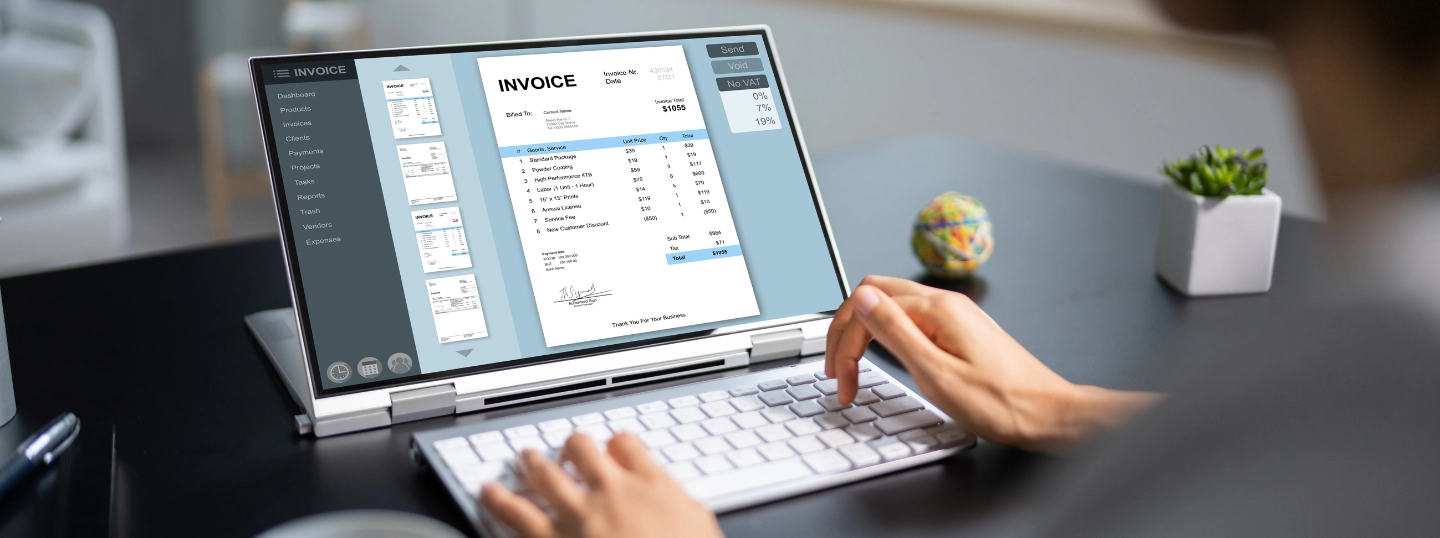
E-invoicing is becoming a major part of the UAE's digital tax transformation. Businesses will need to move from traditional invoices and PDFs to structured electronic invoices that can be exchanged and reported through the UAE e-invoicing framework.
For businesses looking for e-invoicing services UAE, preparing early can make the transition much easier. The right approach involves more than selecting software. Businesses also need to assess their current systems, choose an Accredited Service Provider (ASP), prepare invoice data, integrate accounting systems and train employees
Need help with UAE e-invoicing? Contact us to assess your business requirements and get started.
What Is UAE E-Invoicing and Does It Apply to Your Business?
UAE e-invoicing is the electronic creation, exchange and reporting of structured invoices through approved systems. Unlike a simple PDF invoice sent by email, an e-invoice contains structured data that can be processed automatically by business systems and transmitted through the approved e-invoicing framework. The UAE's e-invoicing model is based on the Peppol framework and uses the PINT AE specification to standardise invoice information.
The rollout is being introduced in phases. The voluntary pilot began in July 2026, followed by mandatory implementation for larger businesses from January 2027 and wider mandatory implementation from July 2027.
The requirement is particularly important for businesses involved in B2B and B2G transactions. Businesses should assess their individual obligations rather than assuming that e-invoicing only applies to VAT-registered companies.
What Makes a Valid UAE E-Invoice?
A UAE e-invoice is not simply a PDF exported from accounting software. To be valid under the Electronic Invoicing System, an invoice must:
- Be issued in structured XML format — PDFs, scans, and paper invoices are not valid
- Use approved standards — PINT AE or UBL format
- Be transmitted through an Accredited Service Provider (ASP) approved by the Ministry of Finance
- Include all mandatory data fields as specified in the UAE e-Invoicing Data Dictionary
- Be reported to the FTA's e-Billing system in real time through the ASP
How UAE E-Invoicing Works — Step by Step
Appoint an Accredited Service Provider (ASP)
All businesses within the UAE e-invoicing scope must appoint an Accredited Service Provider (ASP) in accordance with the applicable UAE e-invoicing requirements and before their relevant appointment deadline. The ASP acts as the intermediary between your business systems and the FTA's e-Billing platform. Businesses with revenue of AED 50 million or more must appoint their ASP by 30 October 2026. Businesses below AED 50 million must appoint their ASP by 31 March 2027.
Map Your ERP or Accounting Data to PINT AE Standard Fields
Your accounting or ERP system must capture all mandatory invoice data fields as specified in the UAE e-Invoicing Data Dictionary. This includes seller and buyer details, TRN numbers, invoice line items, VAT amounts, and transaction descriptions. The ASP works with your technical team to align your existing system with these requirements.
Convert Invoices to Structured XML Format
Once the data is mapped correctly, invoices are converted from their existing format into structured XML using approved standards — either PINT AE or UBL format. PDF invoices, scanned documents, and paper invoices are not valid under the UAE e-invoicing framework and cannot be used as substitutes.
Validate and Enrich Through ASP
Before transmission, the ASP validates each invoice against the UAE e-invoicing schema, checks for missing or incorrect data fields, applies a digital signature, and adds any required system identifiers. This step ensures the invoice will be accepted by the FTA system and the buyer's ASP before it is sent.
Transmit to FTA and Buyer Simultaneously
The ASP transmits the validated invoice in real time through two channels simultaneously — to the FTA's e-Billing system for tax compliance monitoring and to the buyer's ASP so the recipient receives the invoice in a processable format. This dual transmission is a core requirement of the UAE's Peppol-based DCTCE model.
Store E-Invoices Securely
Both the issuer and the recipient are required to retain e-invoices and related records for a minimum of five years. Storage must ensure the integrity of the data and allow retrieval by the FTA when required. Cloud or offshore hosting is permitted under the June 2026 guidelines update, provided the data remains accessible to the FTA upon request.
UAE E-Invoicing Implementation Timeline
| Deadline | Businesses / Requirement | Key Action |
| 1 July 2026 | Businesses participating in the voluntary phase | E-invoicing pilot begins |
| 30 October 2026 | Businesses with revenue of AED 50 million or more | Appoint an Accredited Service Provider |
| 1 January 2027 | Businesses with revenue of AED 50 million or more | Mandatory e-invoicing begins |
| 31 March 2027 | Businesses below AED 50 million | Appoint an Accredited Service Provider |
| 1 July 2027 | Businesses within the mandatory scope | Mandatory e-invoicing begin |
The deadlines make early preparation important. Waiting until the mandatory implementation date can leave businesses with limited time to upgrade systems, clean customer and supplier data, test workflows and train employees.
Our E-Invoicing Services in Dubai & UAE
Implementing e-invoicing involves technology, tax compliance and operational changes. Our e-invoicing services in Dubai are designed to cover these areas together.
Business Readiness Assessment
We review your current invoicing process, accounting software, ERP systems, transaction volumes and business requirements. This helps identify what needs to change before implementation. The assessment can identify issues such as outdated accounting software, incomplete customer information, incorrect tax data and manual invoicing processes.
ASP Selection & Onboarding Support
Choosing the right Accredited Service Provider is an important part of UAE e-invoicing implementation.
We help businesses evaluate suitable ASP options based on their accounting system, transaction volume, industry requirements and integration needs. We can also support the onboarding process.
EmaraTax Registration & Integration
Businesses need to ensure that their tax information and e-invoicing setup are properly aligned with the UAE requirements.
Our team can assist with the relevant registration, configuration and integration steps so that your invoicing workflow is prepared for electronic reporting.
Accounting Software Integration
E-invoicing should not operate as a completely separate process from your accounting system.
We help businesses connect their existing accounting or ERP systems with the required e-invoicing infrastructure. This can reduce manual data entry and improve consistency between invoices, accounting records and tax reporting.
Staff Training & Workflow Setup
Technology alone does not guarantee compliance. Employees need to understand how invoices should be created, corrected, approved and transmitted. We help establish practical workflows and provide training so finance, sales and administrative teams understand their responsibilities.
Ongoing Compliance Management
E-invoicing compliance does not end after implementation. Our ongoing e-invoicing compliance services UAE can help businesses monitor invoice processes, review system issues, maintain accurate records and respond to regulatory changes.
Who Needs E-Invoicing Services in Dubai?
Different businesses will have different implementation requirements depending on their size, activities, transaction types and systems.
SMEs Below AED 50 Million
Smaller businesses have more time before mandatory implementation, but that does not mean they should wait. Businesses below AED 50 million are scheduled for mandatory e-invoicing from July 2027, with the relevant ASP appointment deadline falling in March 2027.
For many SMEs, the biggest challenge will be upgrading accounting software and cleaning invoice data before implementation. Starting early gives businesses time to compare software, select an ASP and test their processes without disrupting daily operations.
Large Businesses With AED 50 Million or More in Revenue
Large businesses have a shorter implementation window. Businesses meeting the AED 50 million threshold are scheduled for mandatory e-invoicing from January 2027 and need to appoint their ASP by October 2026.
These businesses should begin preparation immediately, particularly if they operate multiple entities, use complex ERP systems or process a large volume of invoices.
Free Zone Companies
Free Zone companies should not assume that their Free Zone status automatically removes their e-invoicing obligations. Depending on their transactions and circumstances, Free Zone businesses may fall within the UAE e-invoicing framework. A proper assessment should be carried out to determine the applicable requirements.
Whether your company operates from a Dubai mainland jurisdiction or a Free Zone, our team can review your position and help establish the appropriate compliance approach.
Non-VAT-Registered Businesses
E-invoicing requirements should not be assessed solely by asking whether a business is VAT registered. Businesses that are not VAT registered may still need to consider whether they fall within the UAE e-invoicing framework. Their specific obligations should be assessed based on the applicable rules and transaction types.
Industry-Specific E-Invoicing Solutions
E-invoicing requirements can vary depending on your industry and business transactions. Explore our industry-specific e-invoicing solutions designed to address the needs of different UAE businesses.
- E-Invoicing for Free Zone Companies in UAE – Support for free zone businesses preparing for UAE e-invoicing requirements.
- E-Invoicing for Government Contractors in UAE – E-invoicing support for businesses handling B2G and government-related transactions
- E-Invoicing for Hospitality Businesses in UAE – Solutions for hotels, restaurants, resorts, and other hospitality businesses managing multiple billing workflows.
Explore the solution relevant to your industry to understand the specific e-invoicing requirements and support available for your business.
Why Choose Danburite Corporate for E-Invoicing Services in Dubai?
Danburite Corporate provides businesses with support across accounting, VAT and e-invoicing requirements, allowing companies to manage related compliance needs through one team.
- One Integrated Support Team:
Rather than treating e-invoicing as an isolated IT project, we connect it with your accounting and tax processes.
- Accounting Software Expertise:
Our team works with commonly used accounting platforms, including Zoho Books, QuickBooks and Tally, helping businesses understand how their existing systems can support the transition.
- Mainland and Free Zone Support:
We support mainland businesses operating across different UAE jurisdictions and can assess the e-invoicing requirements applicable to your business structure.
- End-to-End Implementation:
From the initial readiness assessment and ASP selection through integration, testing and ongoing compliance, we provide support throughout the implementation journey.
- Dedicated Point of Contact:
A dedicated team helps coordinate accounting, tax and implementation requirements, reducing the need to manage multiple service providers.
Prepare for UAE E-Invoicing Before the Deadline
The UAE e-invoicing rollout represents a significant change in how businesses create, exchange and manage invoices. The transition is not simply about replacing paper invoices with digital documents. Businesses need to prepare their accounting systems, customer and supplier master data, tax information, workflows and internal teams.
Starting early also gives you time to identify system limitations and resolve them before mandatory implementation begins. If you are looking for an e-invoicing consultant in Dubai, Danburite Corporate can assess your current setup and help you build a practical implementation plan.
Get Your Business Ready for UAE E-Invoicing
The move toward mandatory e-invoicing is approaching quickly. Businesses that start preparing now can make the transition more controlled, reduce implementation problems and avoid unnecessary compliance risks.
Whether you need an initial readiness assessment, ASP selection, accounting system integration or ongoing compliance support, Danburite Corporate can help you prepare for the UAE e-invoicing framework.
FAQs
1. Does e-invoicing apply if I am not VAT registered?
VAT registration alone does not determine whether a business falls within the e-invoicing framework. Businesses that are not VAT registered should assess their specific obligations based on the applicable UAE e-invoicing rules and transaction types.
2. How long does it take to implement UAE e-invoicing?
ERP upgrades, software integration, ASP selection, and staff training typically take six to twelve months to complete properly. Businesses that begin preparation in early 2026 will be ready well ahead of the mandatory rollout. Those that wait risk rushed implementations and compliance gaps
3. Does UAE e-invoicing apply to free zone companies?
Yes, in most cases. Free zone companies are included in the e-invoicing mandate unless their free zone has a specific, confirmed exemption. SMEs should not assume exclusion without verifying their status.
4. What invoice types are covered under UAE e-invoicing?
The framework covers electronic tax invoices, electronic tax credit notes, commercial invoices, electronic credit notes, and self-billed variants. The correct document type depends on the nature of the transaction, the VAT treatment, and whether the buyer or seller issues the invoice.
5. How long must UAE e-invoices be stored?
E-invoices must be retained for a minimum of five years. The June 2026 guidelines update confirmed that cloud or offshore hosting is permitted, provided the data remains retrievable by the FTA when required.
6. Which transactions are exempt from UAE e-invoicing?
Exemptions include B2C transactions, government sovereign activities not in competition with the private sector, international passenger air transport where electronic tickets are issued, ancillary airline services linked to passenger transport, and certain VAT-exempt or zero-rated financial services. Free zone companies are generally not exempt and should assess their specific transactions.
7. Can I continue to use PDF invoices after the mandatory e-invoicing date?
No. PDF invoices — whether emailed or printed — do not qualify as e-invoices under the UAE framework. A valid e-invoice must be in structured XML format, use the PINT AE or UBL standard, and be transmitted through an Accredited Service Provider. Businesses that continue using PDFs after their mandatory date will be non-compliant.
Frequently Asked Questions
What is e-invoicing and when is it mandatory in the UAE?
E-invoicing is the electronic creation, exchange and reporting of structured invoices through the UAE's approved e-invoicing framework. Mandatory implementation is being introduced in phases, with larger businesses scheduled for January 2027 and wider mandatory implementation scheduled for July 2027.
What is an Accredited Service Provider (ASP)?
An Accredited Service Provider is an approved intermediary that facilitates the exchange and reporting of e-invoices within the UAE e-invoicing framework. Businesses required to implement e-invoicing will need to work with an appropriate ASP.

Get Your Business Ready for UAE E-Invoicing
The mandatory deadline is approaching — start your readiness assessment today and avoid last-minute compliance pressure